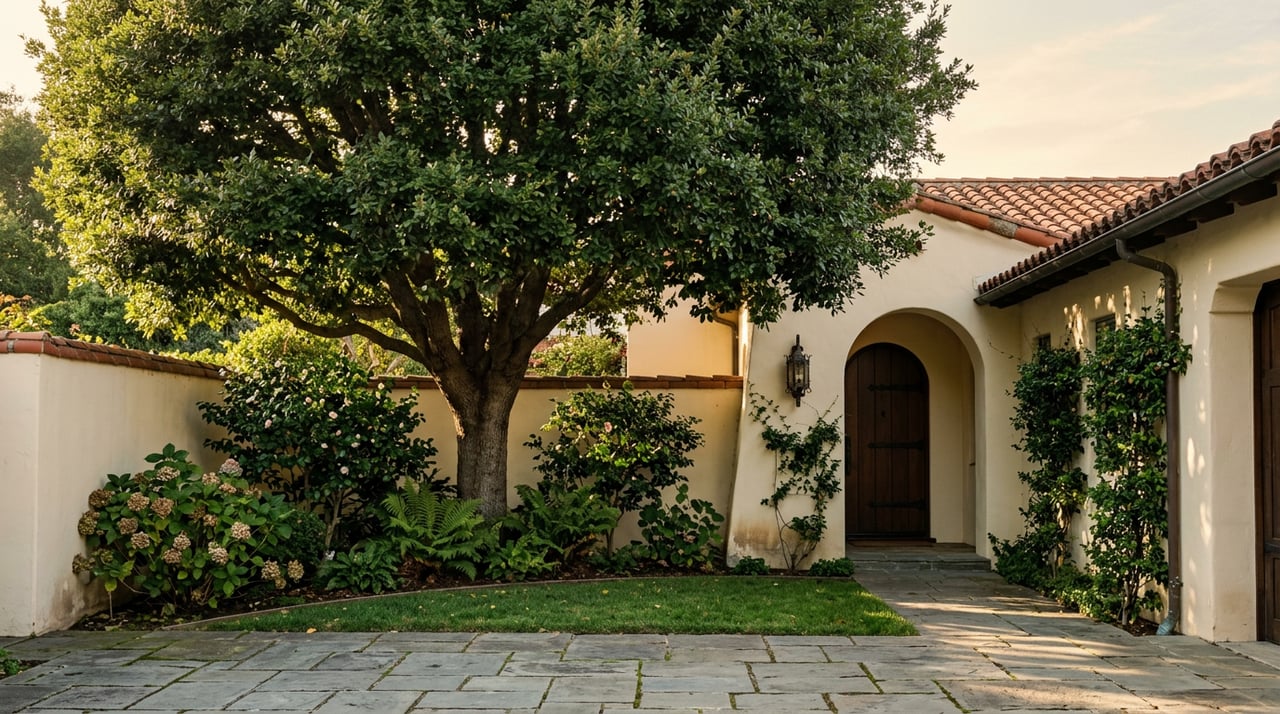
Walk from anywhere near Harvard or Yale toward downtown on a weekday morning and you'll pass three green spaces in under fifteen minutes: Bay Tree Park at Fifth and Dartmouth, De Anza Historical Park along Arroyo Court, and San Mateo's Central Park where B Street meets El Camino Real. Most people who live here treat all three the same way. A spot to let the dog sniff a hedge. A bench to check a phone. A patch of grass between one errand and the next.
They are not the same kind of place, and the difference is not atmosphere. It's origin. Each one exists because a different group of people solved a completely different problem, at different points across more than a century, and none of them were thinking about the other two when they did it. Once you know which is which, you stop wasting a Saturday afternoon at a park that was never built to hold one.
The Estate Tree the Neighborhood Bought by the Square Foot
Bay Tree Park is the smallest of the three and the easiest to walk past without noticing why it's there. It isn't really a park in the sense of something someone designed. It's a preservation project that happened to take the shape of a park.
The story starts with John Parrott, a Virginia-born banker who bought 377 acres of the old Rancho de las Pulgas in 1860 and built a mansion he named Baywood, after a stand of native bay trees on the property that he admired for their height. When the Dunn Williams Company subdivided the estate into 445 residential lots in 1927, laying out streets with names like Harvard and Yale to appeal to San Francisco buyers, most of Parrott's grounds disappeared under new houses. One tree didn't.
The city bought the parcel around that single bay tree in 1973 for $143,000, and part of the purchase price came from residents and organizations who bought individual square feet of the future park for $7.62 each, according to the Baywood Neighborhood Association's history of the neighborhood. The mini-park was formally dedicated on May 12, 1979: a 35,000-square-foot lot built around one tree that measures 20 feet in circumference, stands 70 feet tall, and is estimated to be more than 300 years old, one of the three oldest bay trees in California.
That backstory explains everything about how the park behaves today. It has no play structure, no benches arranged for lingering, nothing to do once you've looked at the tree. It was never meant to be a destination. It was meant to keep one specific object from getting torn out, and it has done exactly that job for close to fifty years.
A Landmark Number, Not a Recreation Facility
According to Redwood City Pulse, De Anza Historical Park is a strip of green along the 100 block of Arroyo Court with a stream and a walking path. It's easy to mistake it for an afterthought, with not much else. There's a reason it has less infrastructure than the other two: it isn't a recreation facility at all. It's a historical marker that happens to have grass around it.
The park carries California Historical Landmark No. 47, which marks the site where Juan Bautista de Anza's expedition camped in 1776 while he was scouting locations for the Presidio and the Mission at San Francisco. The landmark designation is the point of the place. The stream and the path exist because a marker sitting alone in a parking strip would be strange, not because anyone planned recreational programming here.
That makes De Anza the quietest of the three by design, and for residents of Baywood-Aragon, often the fastest to reach on foot. There's no music series, no rose garden, no staff. If you want ten minutes without running into a stroller or a marketplace crowd, this is the one that delivers it every time, because it was never built to attract either.
The One With a Staff, a Rose Garden, and a Bond Measure
Central Park is the outlier of the three, and it's the only one built from the start as a shared civic amenity rather than a preserved object or a historical footnote.
The city purchased the old Kohl estate property through a 1922 bond measure of $80,000, roughly $1.5 million in 2025 dollars, and turned the 16-plus-acre grounds into San Mateo's first public park. The original planting work was done by John McLaren, the same landscape designer behind Golden Gate Park in San Francisco, a detail most people who walk past the Japanese Tea Garden never learn.
The Tea Garden itself was designed by Nagao Sakurai and dedicated in 1966, and it marks San Mateo's sister-city relationship with Toyonaka, Japan. It's open daily, free, with a koi pond, a granite pagoda, and cherry trees that draw a crowd in late winter. A few hundred feet away sits the Rose Garden, planted in 1993 and still maintained entirely by volunteers, more than 150 roses across 100 varieties, tended by the San Mateo Arboretum Society, a nonprofit founded in 1975 and headquartered out of the restored Kohl Pumphouse on the park grounds.
Central Park also runs the only actual programming of the three: the Central Park Music Series brings live bands to the park on summer Thursday evenings starting in mid-June. None of that exists at Bay Tree Park or De Anza, because none of it was ever the point of those two places. Central Park has paid parks staff and a standing volunteer organization behind it. The other two have a tree and a landmark plaque.
Why This Distinction Matters More Right Now
More people are walking this exact stretch of San Mateo than at almost any point in recent memory. Foot traffic on the B Street pedestrian mall, two blocks past where these three green spaces sit, climbed 20 percent between 2024 and 2025 alone and is up 120 percent since 2023, according to reporting from the Redwood City Pulse. Some of that increase is Caltrain riders arriving downtown from farther away. Some of it is neighbors from Baywood-Aragon and the surrounding streets making the same short walk more often than they used to.
That means more people are passing all three green spaces in a single trip than were doing so a few years ago, and more of them are making decisions about where to actually stop based on nothing more than what happens to be closest. Knowing that Bay Tree Park was never built for lingering, that De Anza was never built for programming, and that Central Park is the only one of the three with restrooms, staff, and a season of scheduled events saves you from picking the wrong one for what you actually want out of the walk.
Which One To Actually Walk To
If you've got five minutes and a dog that needs a stop, Bay Tree Park does that job and nothing more. If you want a quiet stretch with no crowd and no schedule to work around, De Anza Historical Park is the one built for exactly that, mostly because nothing else was ever added to it. If you're planning an actual outing, rose garden in bloom, a Thursday evening with live music, a bench near the koi pond, Central Park is the only one of the three equipped for it, because it's the only one anyone ever built to hold a crowd.
None of that means the other two are lesser. A park that exists purely to protect one 300-year-old tree, and a landmark that exists purely to mark a 1776 campsite, are doing exactly what they were built to do. The mistake is expecting all three to do the same thing just because they happen to sit along the same ten-minute walk.
The Baywood Neighborhood Association still works with the city on the everyday friction of living this close to a busy downtown corridor, from parking pressure to street safety. These three green spaces are another part of the neighborhood worth knowing on their own terms.
If you're a longtime Baywood-Aragon resident and you've never actually read the plaque at De Anza or walked the far side of the Rose Garden past peak bloom, this is a good week to close that gap before the season turns.
And if the conversation ever shifts from walking these blocks to owning on one of them, Luis Vasquez has spent years working this exact stretch of San Mateo and can walk you through what a home near any of these three green spaces is actually worth. Reach out for a free Buying & Selling Guide and a market consultation whenever you're ready.