If you pulled the numbers on Bay Meadows this month, you'd have seen the median sale price fall 7.5 percent from a year earlier. If you're comparing Peninsula neighborhoods and that number is doing some of your thinking for you, ask a harder question first: fell for whom, and compared to what?
Because in the same window, the median price per square foot in Bay Meadows didn't fall. It rose 4.9 percent, to roughly $1,070. A neighborhood cannot get both cheaper and more expensive at the same time unless the thing being measured has changed underneath the measurement. That's exactly what happened here, and it's tangled up with a second tax consideration: a special tax district that was built, on purpose, to shift its full weight onto homeowners as the neighborhood approached the end of its build-out. Bay Meadows is nearing the end of its build-out. Both stories are about timing, not value, and a buyer who treats either number as a simple price signal is going to misread the market.
The Median Is Measuring a Different Neighborhood Than It Was a Year Ago
Redfin's trailing three-month figures put Bay Meadows' median sale price at $1.94 million, down 7.5 percent year over year, while the median price per square foot climbed to about $1,070. In the most recent month on record, exactly one house, one condo, and two townhouses closed in the neighborhood. That's a small sample for one month, not the entire sample behind the headline move. With only four sales in a month, the mix of what happened to close can make the monthly median a shaky guide to what buyers were willing to pay for comparable space.
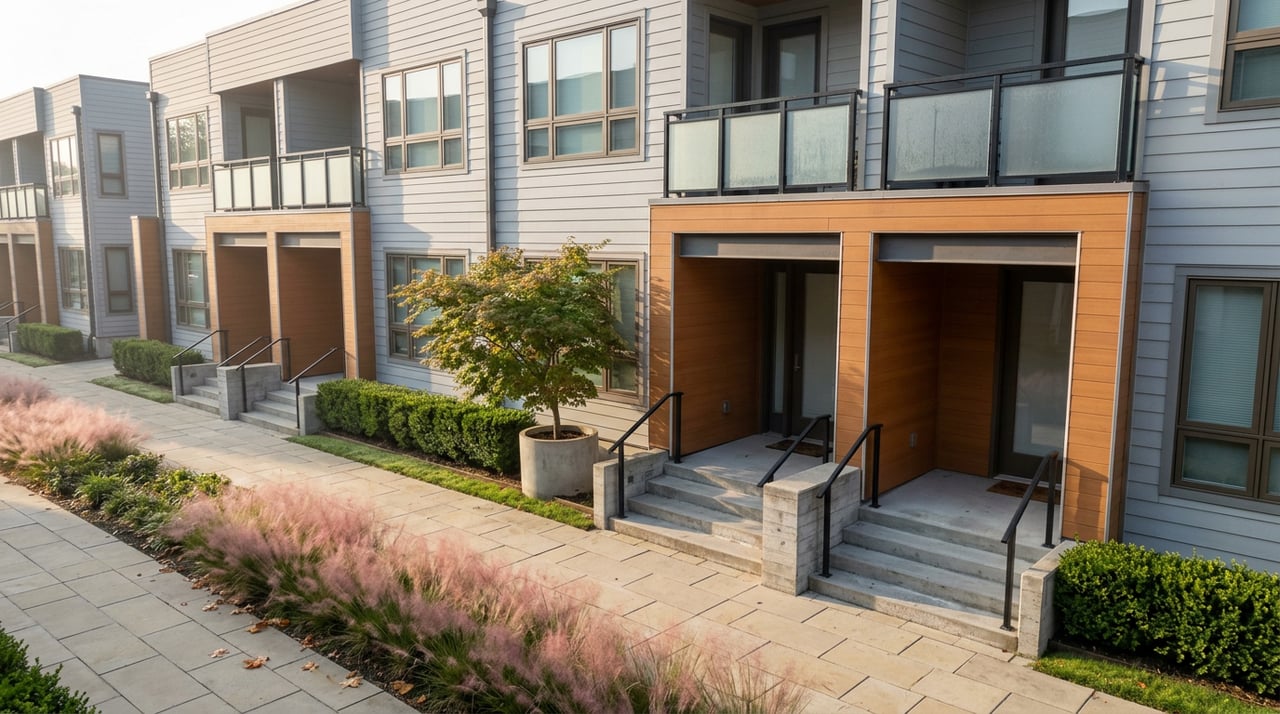
Bay Meadows has spent close to two decades building out in phases, from larger early single-family parcels to a final wave of tighter, transit-adjacent product. Newer communities like Meadow Walk, a 74-unit townhome development, Hawthorne with 54 residences plus a run of three-story townhomes, and Slate at One 90, a 59-unit townhome-style condo project with units running 1,546 to 2,088 square feet, are exactly the kind of smaller, efficient floor plans that cost more per square foot even when the total price tag is lower than a larger detached home a few blocks over. Older condo buildings from earlier phases, including Gateway Commons, Stonegate, and The Lofts at Bay Meadows, add another layer of smaller, higher-density product to the mix.
Put those two facts together and the median's drop reads differently. It isn't that Bay Meadows buyers are paying less for the same home. It's that the neighborhood is finally selling out its smallest, densest, most expensive-per-foot phase, and the four sales in the latest month are one part of the mix shaping the trailing three-month headline. The market itself is still tight: Redfin's competitiveness score for Bay Meadows sits at 93 out of 100, and homes are moving in roughly two weeks. That's not the profile of a cooling neighborhood. It's the profile of a neighborhood whose inventory changed shape.
The Other Number That Migrated This Year
There's a second mechanism at work in Bay Meadows, and it has nothing to do with square footage. When the City of San Mateo created Community Facilities District No. 2008-1 in 2008 to bond against roughly $57 million in infrastructure costs, the tax was structured with a built-in handoff. In its first year, the special tax generated about $1.9 million, and roughly 90 percent of that came from the developer and builders, Wilson-Meany, TRI Pointe Homes, and Shea Homes, according to the San Mateo Daily Journal's reporting on the city council's authorization of the levy. Only 10 percent, spread across 15 parcels, landed on the earliest homebuyers.
That split was never meant to hold. The city's finance director at the time said the annual assessment would grow as the project progressed, until eventually every new owner carried the special tax in full. New buyers signed an affidavit acknowledging the obligation and confirming the city held no liability for it.
The arrangement was designed to move the levy from the builders' balance sheet to homeowners once the last unit closed.
The specific dollar figure varies by parcel and shows up as its own line item on the property tax bill, listed under the CFD No. 2008-1 designation. One contemporaneous report on the levy's authorization put the expiration at 2042. The parcel-specific term is worth confirming. Before writing an offer on a Bay Meadows home, ask the title company to pull the parcel's specific CFD payoff schedule, not the neighborhood's general one.
What This Actually Costs, and What It's Being Compared Against
San Mateo County's effective property tax rate, once local bonds and special assessments are layered on top of the 1 percent Proposition 13 base, runs roughly between 1.08 percent and 1.52 percent depending on the tax code area, with a countywide average close to 1.25 percent. A Bay Meadows home carrying a full CFD assessment sits toward the higher end of that band.
| Bay Meadows | Older pre-1982 Peninsula stock | |
|---|---|---|
| Base property tax | 1% of assessed value | Same |
| Effective rate | Trends toward the higher end of the county's 1.08%–1.52% range | Typically sits close to the 1% base |
Neither column is the "better" one. A neighborhood like Sunnybrae or The Village offers older housing stock and no walk to a Caltrain platform. Bay Meadows offers new construction, a town center along Delaware Street with a public market and Blue Bottle Coffee, and the Hillsdale Caltrain station sitting at its edge.
Before you compare a Bay Meadows listing against something in an older part of San Mateo, pull three documents: the Natural Hazard Disclosure report, the property's most recent tax bill, which itemizes the special tax as its own line, and the preliminary title report once you're in contract, which will show the bond's remaining term. Skipping any of the three means comparing a number that includes the tax against one that doesn't.
A Few Direct Questions
Will the tax eventually go away? Yes, once the underlying bonds are retired. The parcel-specific title report matters more than a general answer.
Does the falling median mean Bay Meadows is a better deal right now? Not on its own. The drop tracks with which unit types happened to close in a small sample, not with buyers paying less for comparable space. The price-per-square-foot trend, which rose over the same period, is the more honest read on what similar homes are actually commanding.
Numbers like these are exactly why a single median on a portal page rarely tells the whole story, especially in a neighborhood that changed shape as fast as Bay Meadows has. If you're weighing it against another part of San Mateo County, or you want the actual CFD figure and remaining term pulled for a specific address before you write an offer, that's the kind of groundwork Luis Vasquez does before a client ever submits a number. Get your free Buying & Selling Guide and schedule a market consultation to see what a Bay Meadows home actually costs to own, not just to close on.
This article is general information, not legal, tax or financial advice. Consult a qualified professional about your situation.